Wool is a natural, protein-based fibre grown by sheep. Each wool fibre is made from keratin and has a unique layered structure that gives it softness, breathability, elasticity, moisture management, odour resistance and natural temperature regulation. Merino wool is particularly valued because its exceptionally fine fibres feel soft against the skin while providing high performance across a wide range of apparel.
At a glance
✓ Natural animal fibre
✓ Renewable
✓ Biodegradable
✓ Protein-based (keratin)
✓ Breathable
✓ Temperature regulating
✓ Moisture managing
✓ Naturally odour resistant
Why is Wool Unique?
Unlike synthetic fibres, wool has evolved naturally over millions of years. Its unique internal structure enables it to regulate temperature, absorb moisture vapour, resist odours and recover from stretching, making it one of nature's most sophisticated textile fibres.
Wool Fibre Diameter
One of the biggest factors influencing the feel of Merino wool is fibre diameter. Measured in microns, finer fibres feel softer against the skin, while broader fibres are better suited to more durable applications. One micron is equal to one millionth of a metre.
Merino wool fibre diameter typically ranges from less than 17.5 microns to around 22-24 microns. Finer fibres, generally below about 19.5 microns, are prized for next-to-skin garments such as base-layers and fine knitwear due to their softness. Medium-range fibres, around 19.5 to 22 microns, are commonly used in apparel including knitwear and outerwear. Broader fibres above this range are less common in apparel and are more often used in interior textile applications such as carpets and rugs.
Different fibre diameters are suited to different end uses, allowing Merino wool to be crafted into everything from luxury knitwear and tailoring to technical sportswear and interior textiles.
| Fibre diameter | Typical use |
|---|---|
| <19.5 μm | Base layers, underwear, fine knitwear |
| 19.5–22 μm | Apparel, knitwear |
| 22–24 μm | Outerwear |
| >24 μm | Carpets and interiors |
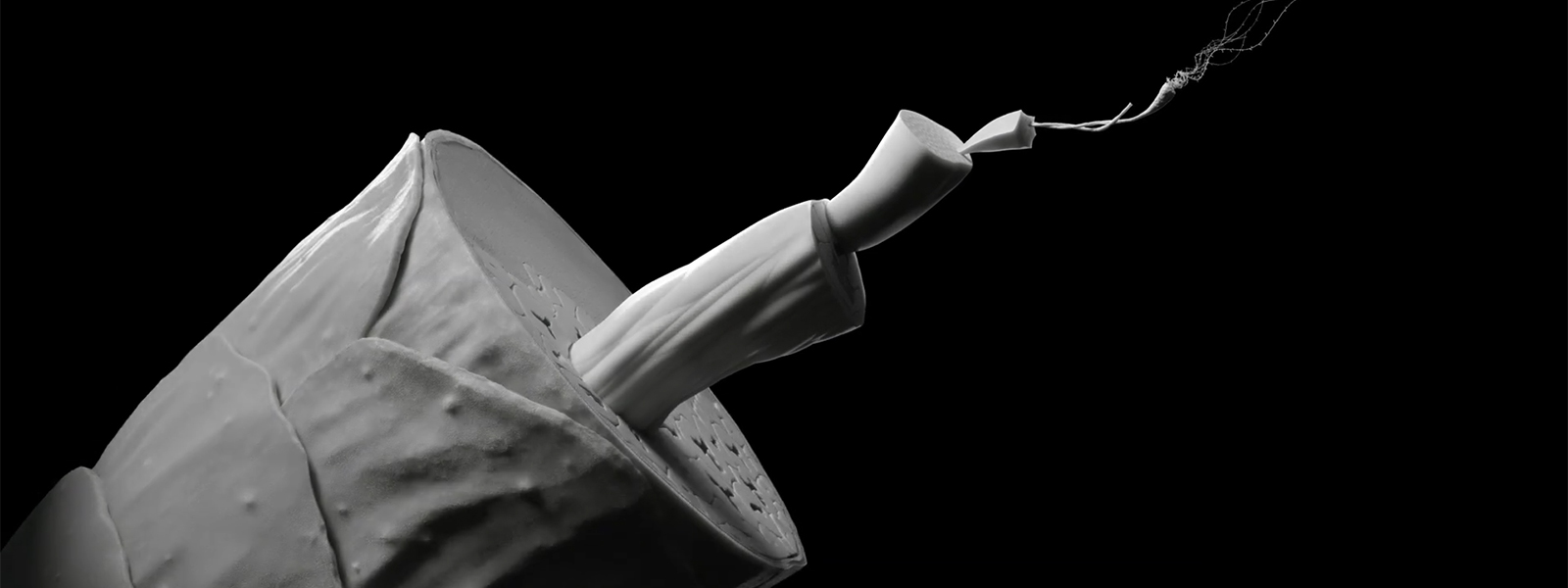
The Wool Fibre Structure
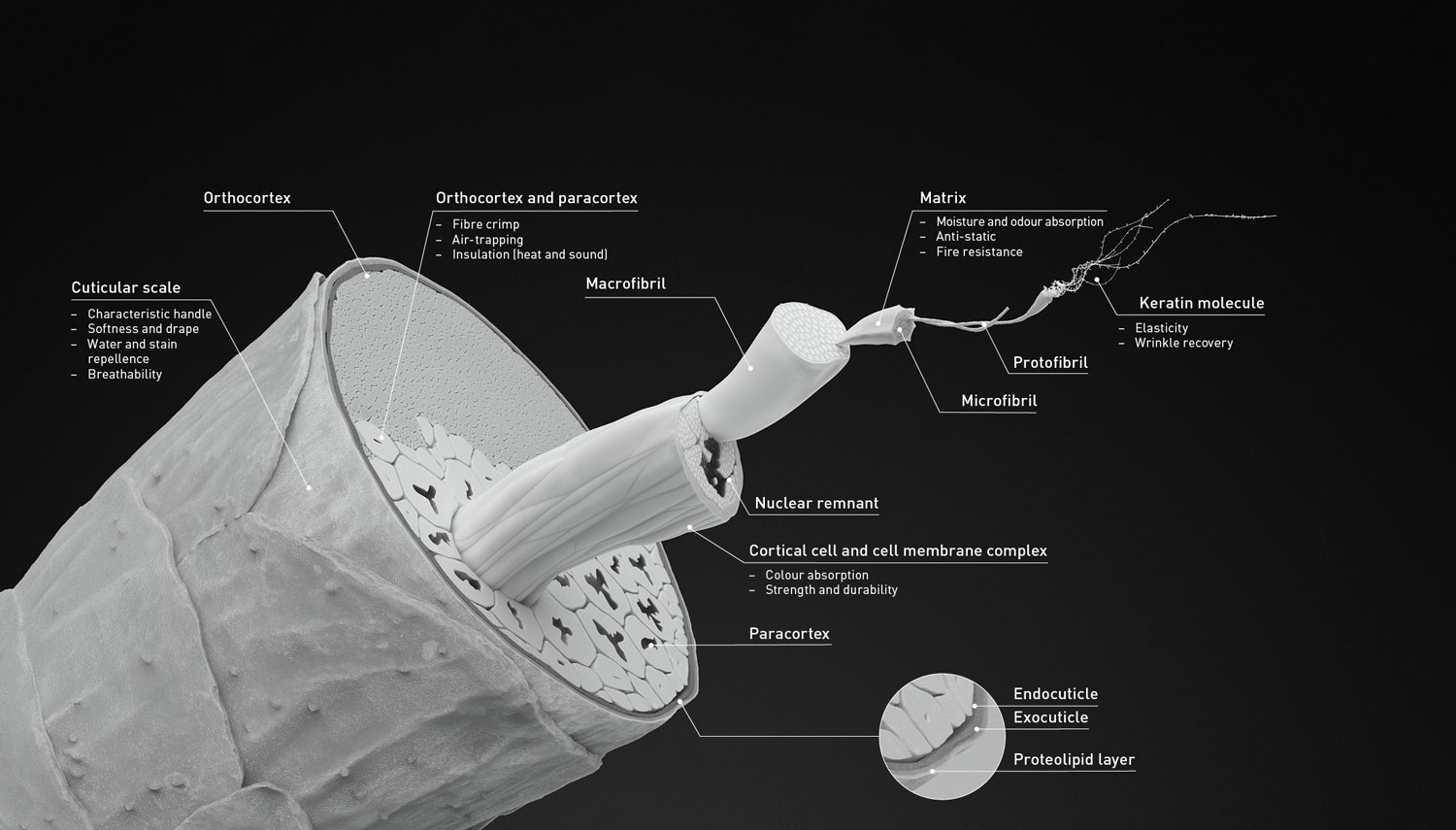
The structure of the wool fibre can be divided into several elements, including the cuticle and cortex layers, as well as substructures including the cortical cell and cell membrane complex, macro- and microfibrils and the matrix. Each of these elements contribute to the wool fibre’s performance from regulating temperature to odour resistance, softness and natural elasticity.
Each year, sheep continuously produce a new fleece which is shorn seasonally. Wool is made of the proteins, lipids and minerals naturally absorbed and biologically synthesised through a sheep’s diet, with the fibre made of about 97% protein and 2-3% lipid material. Merino wool is chemically and structurally much like the hair found on other animals, but the fibre’s fineness, crimp structure, outer and inner fibre structure provide comfort, durability, elasticity, wrinkle recovery and ability to manage moisture and odour.
The wool fibre is composed of keratin, a natural protein also found in human hair, along with small amounts of calcium, sodium and lipids. Merino wool is used across textiles from fashion to performance wear and is valued for several natural fibre properties:
- Superior Comfort: very fine fibres that are soft against the skin.
- Performance Benefits: natural temperature regulation, odour resistance and moisture management due to the fibre’s natural structure.
- Renewable: Merino wool comes from Merino sheep that continuously grow a new fleece each year.
- Biodegradability: 100% Merino wool is biodegradable in land and marine environments.
- Recyclability: Wool is the most recycled apparel fibre in the world, with up to 6% of all wool fibre undergoing mechanical recycling.
- Versatility: Merino wool’s natural fibre structure makes it a versatile fibre for use across textile products, from fashion to performance wear such as base-layers, mid-layers and outer-layers.
Every part of the wool fibre has a purpose. Its natural structure creates a unique combination of softness, breathability, elasticity, durability and moisture management that few other fibres can match.
The Layers of the Wool Fibre
Every layer of the wool fibre contributes to its natural performance.
The cuticle: nature's protective outer-layer
The cuticle is the wool fibre’s outer shell. This protective layer is made from overlapping scales that sit in a stacked formation like roof shingles. These scales guard the cortex underneath to repel moisture like light rain.
The hydrophobic nature of wool’s cuticular scales helps prevent water-based liquids from seeping deeper into the fibre. This capability assists with wool’s natural stain resistance. The combination of a hydrophobic outer-layer and a hydrophilic inner core means that wool is hygroscopic; and can retain moisture vapour without feeling wet.
The cortex: where comfort and temperature regulation begin
The cortex makes up the bulk of the wool fibre. Sitting beneath the cuticle, the cortex is made from two different cell types: the orthocortex and the paracortex. These cell types grow side by side, but at different rates, to create a natural bend in the fibre known as crimp.
The crimp, or waviness, of the wool fibre is what gives wool fabric part of its breathability and temperature management qualities, as well as playing a part in softness and comfort. The crimp structure helps to trap static air between the skin and the wool fabric, creating a microclimate next to the skin to naturally maintain temperature. This not only keeps skin free from uncomfortable sweat but also insulates from cold weather and provides evaporative cooling in hot weather.
The elasticity of the wool fibre is also contributed to by the wool fibre’s crimp, which allows the fibre to stretch and recover without breaking. This spring-like quality also helps wool fabrics to resist wrinkles and maintain shape.
The Cortical Cell and Cell Membrane Complex
Inside the protective casing of the cell membrane complex is a structure called the cortical cell, which gives Merino wool its strength, abrasion resistance and durability. The cortical cell is made from a crystal-like structure, called the crystalline region, which has a highly ordered molecular arrangement that looks like crystals. This gives the wool fibre mechanical properties that include the ability to withstand bending or stretching as well as structural integrity under strain.
Sitting alongside the crystalline region is another area called the non-crystalline region. Unlike its neighbour, the non-crystalline region is less organised in its molecular arrangement and is responsible for the flexibility of the fibre.
The non-crystalline region is also high in sulphur, which can help to absorb dyes to give longer lasting colours that don’t bleed when washed or fade over time. The cell membrane complex is also a transport channel for moisture, oils and dye molecules to pass through the wool fibre, making it a strong, flexible, breathable, easy to colour fibre.
Macrofibrils and microfibrils: strength with flexibility
Inside the wool fibre’s cortex, keratin proteins are organised into bundles called macrofibrils and microfibrils. These look like tightly wound ropes made of many smaller strands, which gives the wool fibre its tensile strength and flexibility.
These keratin molecules provide elasticity and wrinkle recovery because of their spiralled helix shape, which helps wool fabrics to recover quickly from being folded or compressed. In particular, microfibrils help the fibre to bend and recover repeatedly - bouncing back like a spring - without damaging the integrity of the wool fibre.
Matrix: moisture and odour management
The Merino wool fibre’s matrix is the non-crystalline region found deep inside the fibre. It’s made from high-sulphur proteins with special properties that allow them to absorb moisture and odours. The matrix has hygroscopic properties, which means it can absorb and retain liquid moisture, including sweat and moisture vapour from areas of high humidity next to the skin.
The high-sulphur proteins in the matrix can capture odour-causing molecules generated by sweat. This action creates a natural odour-control mechanism that maintains a fresh wear even after long periods. When sweat on the skin releases odour-forming molecules, these molecules can migrate into the wool fibre and attach to polar amino acids in the matrix. These odour molecules are held by the wool fibre until being released in the next wash.
How the Wool Fibre Works
| Fibre structure | Benefit |
|---|---|
| Cuticle | Protects the fibre |
| Crimp | Insulation |
| Cortex | Elasticity |
| Keratin | Strength |
| Matrix | Moisture and odour management |
Natural Fibre Properties
Softness
Merino wool's fine fibres bend easily against the skin, reducing the prickle sensation associated with coarser wool.
Breathability
The wool fibre naturally manages heat and moisture because its internal structure can absorb water vapour while allowing excess heat to escape.
Temperature regulation
The fibre's natural crimp traps insulating air in cold conditions while releasing excess heat and moisture in warmer environments.
Odour resistance
Keratin proteins naturally bind odour molecules until the garment is washed.
Elasticity
The spring-like molecular structure allows the fibre to stretch and recover.
Durability
The cortex and keratin structure provide excellent strength and wrinkle recovery.
FAQs
What is the wool fibre?
Wool is a natural fibre grown by sheep. Each fibre is made from complex layers that work together to make wool naturally soft, breathable, durable, odour-resistant and thermoregulating.
Where does wool come from?
Wool comes from the fleece of sheep, which is shorn seasonally. Each year, sheep naturally grow a new fleece, making the wool fibre a renewable resource.
What is wool made of?
Wool is primarily made from keratin, a natural protein also found in human hair and nails. It also contains lipids and minerals absorbed through the sheep’s diet.
What kind of fibre is wool?
Wool is a natural, protein-based animal fibre. Unlike synthetic fibres, wool is biodegradable and renewable, with performance properties including breathability, temperature management, elasticity, odour management and moisture management.
What protein is in the wool fibre?
The main protein in wool is keratin. The helix-shaped molecular structure of keratin helps to give wool its elasticity, strength and resilience.
What makes the wool fibre strong?
The wool fibre’s strength comes from its inner structure, especially the crystalline regions of the cortical cells and bundles of keratin proteins in the macrofibrils and microfibrils. These give wool high tensile strength and durability.
How does wool keep me warm?
Wool fibres have a natural crimp, which traps tiny pockets of air next to the skin. This creates an insulating layer that helps to maintain body temperature, keeping you warm in cold weather, and cool in the heat.
What makes Merino wool so soft?
Merino wool is soft because its fibres are exceptionally fine and bend easily against the skin, avoiding the prickle sensation that causes itchiness.
Is wool a natural fibre?
Yes. Wool is a natural, protein-based fibre grown by sheep. Unlike synthetic fibres made from fossil fuels, wool is renewable because sheep naturally grow a new fleece each year. Wool is also biodegradable under the right environmental conditions and valued for its natural comfort and performance properties.
Is wool biodegradable?
Yes. Wool is a biodegradable natural fibre made primarily from keratin, a protein that can naturally decompose in soil and marine environments under suitable conditions. Unlike many synthetic fibres, wool breaks down over time and returns valuable nutrients such as nitrogen and sulphur to the environment.
Why is wool breathable?
Wool is naturally breathable because its unique fibre structure absorbs and releases moisture vapour while allowing heat to escape. This helps regulate body temperature by keeping you warm in cold conditions and cooler in warmer weather, making wool comfortable to wear across a wide range of climates and activity levels.
Why is wool naturally odour resistant?
Wool is naturally odour resistant because its keratin proteins can absorb and temporarily bind odour-causing molecules produced by sweat. These molecules remain trapped within the fibre until they are released during washing, helping wool garments stay fresher for longer than many other fibres.
What is wool crimp?
Crimp is the natural waviness of a wool fibre. This three-dimensional structure creates tiny pockets of air that provide insulation, improve breathability and contribute to wool's natural elasticity and softness. Crimp also helps wool fabrics recover their shape after stretching or compression.
Why is Merino wool softer?
Merino wool is softer because its fibres are exceptionally fine and bend easily against the skin. Unlike coarser wool fibres, which are more likely to create a prickling sensation, fine Merino fibres flex when they touch the skin, making them comfortable for next-to-skin garments such as base layers and knitwear.
What is keratin?
Keratin is the natural protein that forms the structure of wool fibres, as well as human hair and nails. Its unique molecular structure gives wool strength, elasticity and resilience, allowing the fibre to stretch, recover and maintain its shape while providing long-lasting performance.
Why is wool used in sportswear?
Wool is widely used in sportswear because it naturally regulates temperature, manages moisture, resists odours and remains comfortable across changing conditions. Fine Merino wool is commonly used in base layers, activewear and outdoor clothing because it helps keep the wearer dry, comfortable and fresh during both high- and low-intensity activities.
Is wool waterproof?
No. Wool is not waterproof, but it is naturally water resistant. The fibre's outer cuticle helps repel light moisture, while its internal structure absorbs moisture vapour without feeling wet against the skin. This combination allows wool to remain comfortable in changing weather conditions while continuing to regulate temperature.
What makes wool different from synthetic fibres?
Wool differs from synthetic fibres because it is a natural, renewable, protein-based fibre grown by sheep rather than being manufactured from fossil fuels. Its complex fibre structure provides natural breathability, moisture management, temperature regulation, elasticity and odour resistance without relying on chemical treatments, making it suitable for a wide range of apparel and textile applications.
GLOSSARY
Wool fibre diameter: The thickness or width of a wool fibre, measured in microns (one millionth of a metre). Merino wool ranges from below 17.5–22–24 micron.
Micron (μm): A unit of measurement equal to one millionth of a metre, used to measure fibre diameter.
Cuticle: The outer shell of the wool fibre, made from overlapping scales.
Cortex: Located beneath the cuticle.
Crimp: The natural waviness of wool fibres.
Cortical Cell: A structure inside the cortex that provides strength and durability.
Cell Membrane Complex (CMC): A transport channel surrounding cortical cells.
Macrofibrils: Large keratin protein bundles inside the cortex.
Microfibrils: Smaller keratin bundles within macrofibrils.
Keratin: A fibrous protein.
Matrix: The non-crystalline protein region deep inside the fibre.
Hydrophobic: The ability to resist interaction with water.
Hygroscopic: The ability to absorb and retain moisture vapour.
Odour Control: A natural property of the wool fibre.
Tensile Strength: The ability of a fibre to resist breaking when stretched.
Related wool fibre information
This page explains the science behind wool fibre structure, Merino wool and performance. For a broader introduction to wool as a natural fibre and its benefits, visit the main Wool Fibre page.